Got questions about AI for your dealership?
Ask our AI Advisor →

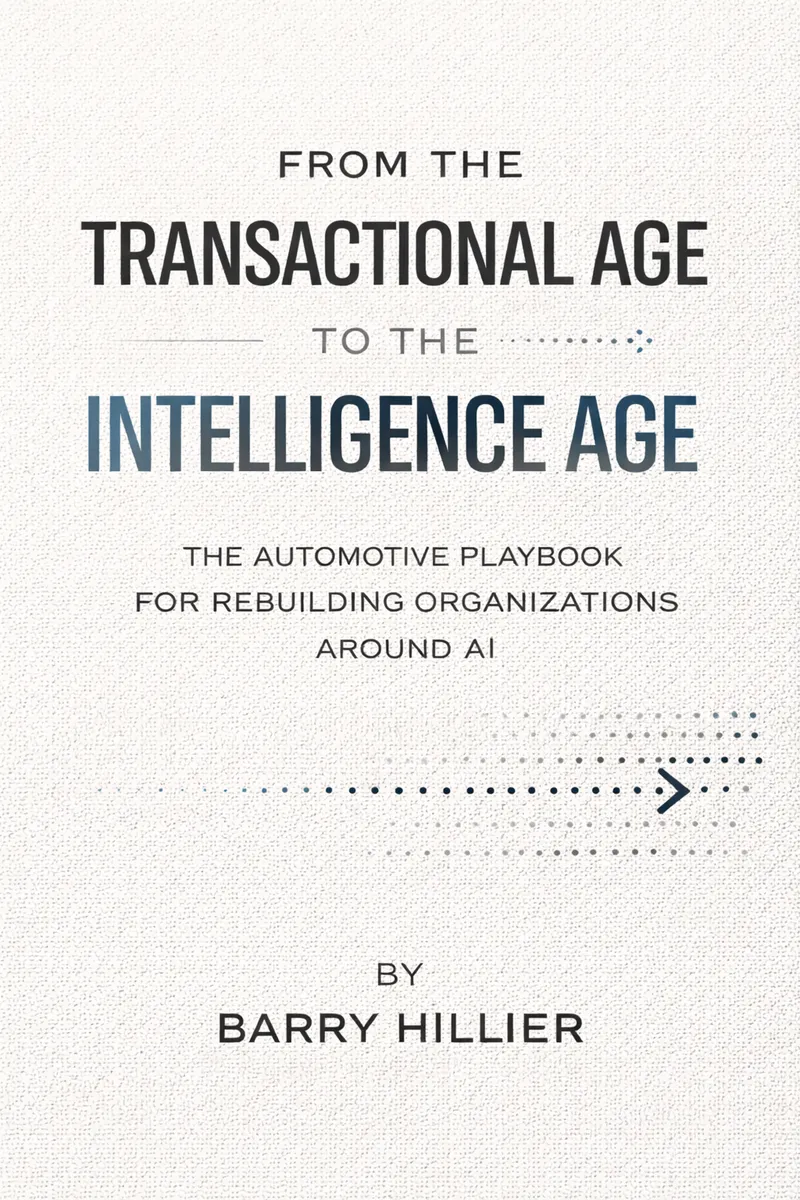
From the Transactional Age to the Intelligence Age
The Automotive Playbook for Rebuilding Organizations Around AI
By Barry Hillier, CEO of Auto Agentic AI
You're Not Failing at AI. You're Succeeding at the Wrong Version of It.
Walk into any dealership or OEM today, and you'll hear the same story: "We're implementing AI." CRM intelligence. Service optimization. Predictive analytics. Impressive dashboards. Measurable wins.
And yet, something feels heavier instead of lighter. More systems to reconcile. More meetings to align intelligence. More decisions requiring human coordination between AI recommendations.
There's a reason for that. And it's not your execution.
Listen to the Full AI Playbook
Prefer to listen? The complete AI Playbook is now available as a full chapter reading — perfect for your commute or whenever you're on the go.

Full Chapter Reading
Every chapter of From the Transactional Age to the Intelligence Age read aloud — covering strategic frameworks, the 7-Stage Intelligence Maturity Model, and practical implementation tools for automotive leaders.
-
Complete unabridged chapter readings
-
Available on all major podcast platforms
-
Free to listen — no registration required
What 70 Years of AI History Reveals About Your Current Strategy
This book traces a pattern that repeats across seven decades of artificial intelligence development—and explains why your organization is experiencing it right now:
Intelligence doesn't emerge from accumulating smart tools. It emerges from architecture.
What's Inside This Book
Strategic frameworks, honest assessments, and practical tools for building automotive intelligence architecture.
Part 1: Understanding the Shift
- Why AI isn't another technology upgrade—it's an organizational age transition
- How coordination, not capability, determines AI success or failure
- The technical foundations every leader must understand
- Why data lakes, retrieval architecture, and agentic systems matter strategically
Part 2: Diagnosing What You're Actually Building
- Coordination Debt: The hidden cost when AI tools don't coordinate
- The 7-Stage Intelligence Maturity Framework
- The Executive Paradox: Why Digital Age success creates Intelligence Age blindness
- The Mirror Test: Honest assessment tools for your AI investments
Part 3: Strategic Architecture and Implementation
- OEM-dealer intelligence coordination and industry power dynamics
- The pioneer's strategic choice: building during formation vs. adopting during maturation
- Vision of the 2030 automotive intelligence landscape
- Practical tools: Assessment frameworks, vendor evaluation, implementation roadmaps
Appendix: Practical Tools for Immediate Implementation
The appendix transforms strategic concepts into executable action with ready-to-use frameworks designed for immediate organizational application.
Strategic Assessment & Diagnostic Tools
AI Architecture Principles (Page 130)
The foundational design guidelines that ensure every AI investment builds toward coordination rather than fragmentation—your strategic filter for all technology decisions.
Using This Book's Tools (Page 131)
Implementation sequencing guide showing how to apply assessment frameworks systematically to diagnose current position and design intelligence architecture pathways.
AI Investment Audit (Page 133)
Comprehensive evaluation framework determining whether your current AI systems can share intelligence and coordinate decisions—or operate as isolated tools creating coordination debt. Takes 30-45 minutes, provides immediate clarity on architectural vs. tool-based progress.
Intelligence Readiness Assessment (Page 135)
Leadership and organizational capability diagnostic measuring whether your team possesses the literacy, culture, and commitment required for systematic intelligence coordination success.
Implementation & Architecture Guides
Principles of AI Design (Page 145)
The five core architectural disciplines—coordination by design, learning architecture, predictive foundation, human-AI partnership, and adaptive systems—that determine whether each new AI investment strengthens collective intelligence or fragments it.
Data Architecture for Intelligence (Page 152)
Technical and organizational requirements for building memory foundations that enable agentic systems to perceive, learn, and coordinate across the enterprise rather than operate in departmental isolation.
Vendor Evaluation Framework (Page 173)
Strategic procurement criteria distinguishing vendors who enable intelligence coordination from those who create sophisticated silos—protecting strategic optionality while building systematic capability.
Each tool is designed for executives, not engineers—providing strategic clarity and decision frameworks without requiring technical expertise.
Who This Book Is For
Download Your Free Copy
181 pages of strategic frameworks and practical tools for building automotive intelligence architecture that creates sustainable competitive advantage.
This Is Not a Vendor Pitch. It's a Field Manual.
This book isn't about selling a product. It's about providing the frameworks automotive leaders need to think architecturally about AI during the formation period—when standards are still being written and strategic choices still matter.
The organizations that engage with these ideas during formation will help define what automotive intelligence becomes. Those that wait for proven playbooks will implement standards established by others.
What Leaders Are Saying
Industry leaders share their perspective on the Intelligence Age transition.
Finished Barry Hillier's From the Transactional Age to the Intelligence Age.
The shift isn't "add AI tools." It's building intelligence as an organizational capability. When AI gets deployed as isolated point solutions, you don't get speed, you get coordination debt: more handoffs, more reconciliation, more meetings.
Barry's maturity model is a useful lens, especially the jump from functional AI to unified intelligence. It's a simple way to check whether your AI work is creating shared context and repeatable decisions, or just adding complexity.
If you're leading AI in automotive (dealer, OEM, fleet, or vendor), it's worth your time.
Stephen Southin
CEO/Founder, Halo Eye Inc