
The book · 181 pages · Free
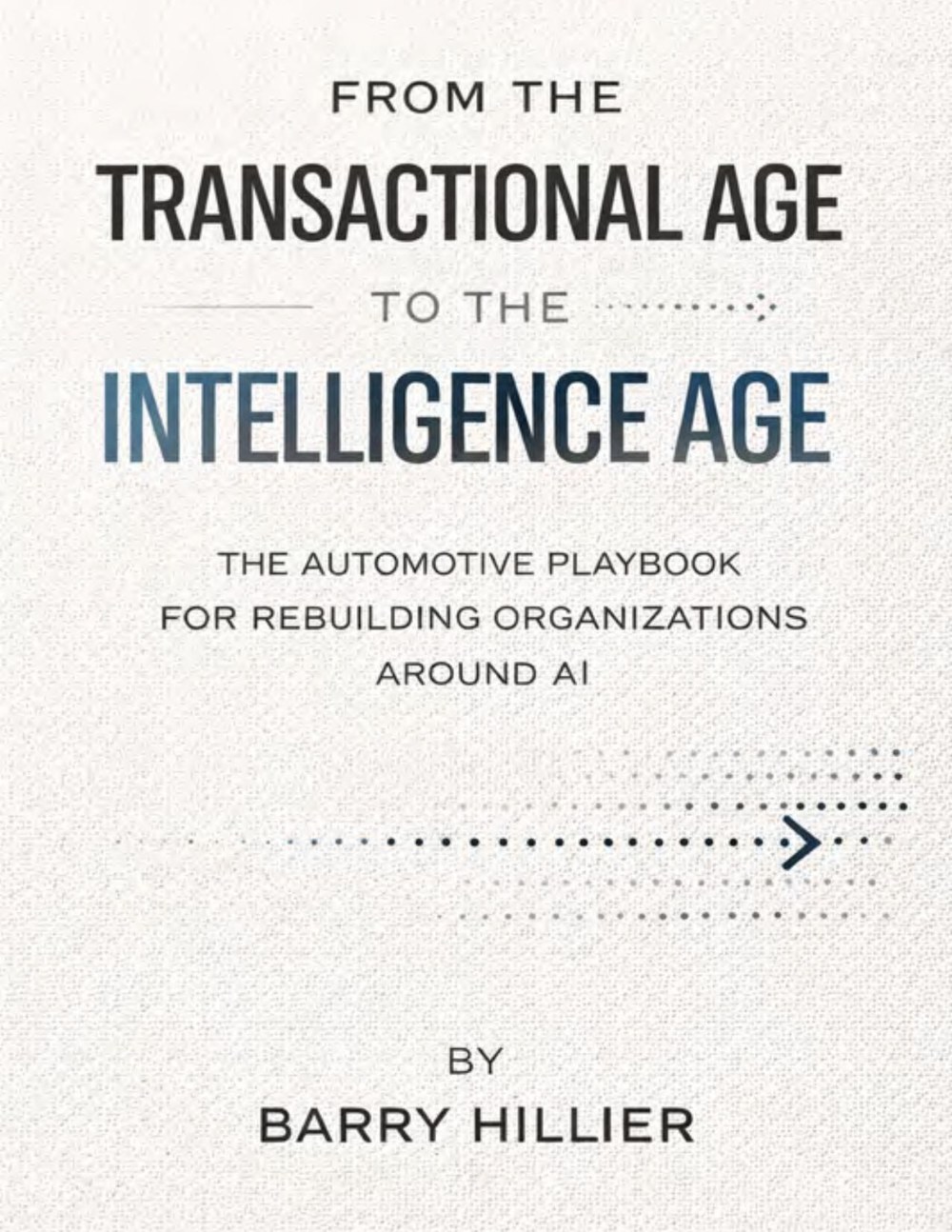
From the Transactional Age to the Intelligence Age
A book about what AI makes possible for automotive organizations — and what it quietly makes harder to sustain.
Written from inside the transition, not after it. Not a guide to tools, vendors, or use cases — an attempt to understand what kind of organization this technology makes possible, and how intelligence stops living inside systems and starts living inside the company.
Barry Hillier · 2026
- 12
- Chapters
- 7
- Appendix tools
- 181
- Pages
What this video says
- Barry introduces the argument: you can't adopt intelligence, you have to build it.
- Maps the twelve chapters onto the maturity levels a dealership group moves through.
- Explains who the appendix tools are for and how to use them with a leadership team.
The argument
You can’t adopt intelligence. It has to be designed.
Most organizations believe they are in the optimization phase of AI: better tools, tighter integration, sharper return. The book’s case is that the industry has already entered the architecture phase — mostly without noticing.
Organization A
Accumulates
- Buys capable tools, one department at a time.
- Each system holds its own version of the customer.
- People reconcile between systems by hand.
- Every new tool adds to the reconciling.
- Progress is real, and it stops compounding.
Organization B
Designs
- Builds the connective foundation first.
- Agrees what each term means, once.
- Systems share context instead of copies.
- Each deployment starts further ahead than the last.
- Advantage accumulates in the architecture, not the tool.
The book’s central term is intelligence architecture. Its central warning is coordination debt — the growing effort of reconciling intelligence that was never designed to work as one system.
Contents
What’s inside.
The first part reframes the problem. The middle diagnoses what organizations are already experiencing. The later chapters move into architecture, maturity, and leadership responsibility.
- 01You Can’t Adopt (Artificial) IntelligenceWhy tools don’t become intelligence.p.8
- 02Why This History Determines Your AI OutcomeWhat earlier industrial transitions already taught us.p.15
- 03AI Literacy for Automotive LeadersWhat AI can do, what it can’t, and what to ask.p.24
- 04Why Adding AI Tools Creates Coordination DebtThe psychology, economics, and structure behind the debt.p.46
- 05From Tools To IntelligenceIf coordination debt is the disease, architecture is the cure.p.54
- 06The Executive Paradox: Managing AIWhy leaders who won the digital era struggle in this one.p.65
- 07The Human Architecture ProblemWhy intelligence fails inside organizations that can’t hold it.p.74
- 08When Success Masks the Real ProblemThe pilot that works and the problem it hides.p.88
- 09The Mirror TestWhere are you really on AI intelligence?p.96
- 10Why OEMs Are Part of Your Intelligence Architecture StoryWhat the network relationship changes.p.103
- 11The Pioneer’s Strategic ChoiceWhen to pioneer, and when to follow.p.115
- 12The AI Future We’re BuildingA vision of pioneer success.p.119
- —About Barry Hillierp.125
- —About Auto Agentic AIp.126
Use them in order · each builds on the last
Seven tools in the appendix.
The back half is working material, not further reading: diagnostics to run on your own operation, design principles to hold new investments against, and a vendor-evaluation framework to use during procurement.
- 01p.127
AI Architecture Principles: A Guide
The design guidelines every later tool is measured against.
- 02p.128
Using This Book’s Tools
How to run the appendix with a leadership team.
- 03p.130
AI Investment Audit
Can your current systems share intelligence, or only reports?
- 04p.132
Readiness Assessment
Leadership literacy and organizational capability, scored honestly.
- 05p.142
Principles of AI Design
Five principles: coordination, learning, prediction, partnership, adaptation.
- 06p.149
Data Architecture
The infrastructure that lets systems share context instead of copies.
- 07p.170
Vendor Evaluation
Procurement questions that keep the next purchase from adding debt.
Get it
Tell us who you are, and it’s yours.
Four fields. We ask so we know which parts of the book are actually useful to the people reading it.
Where next
The book is the thinking. The walkthrough is the doing.
Read the book for the argument. Then take the walkthrough to see what it looks like inside a store — the workflows, the stages, and who approves what.
The doing
Open the walkthrough
Eleven sections, open, and ungated: what gets engineered, what runs, and what your people do differently.
See how it worksThe questions
Ask the advisor
Put the argument to it — coordination debt, intelligence architecture, what changed between the digital era and the Intelligence Age.
Ask a questionFrom the Transactional Age to the Intelligence Age · Barry Hillier · 2026
Ask the advisor
Start with the idea you want tested.
The book makes an argument. Put it to the advisor — the concepts, how AI arrived in automotive, what coordination debt costs a group, and what a human architecture has to hold. It carries the conversation forward from there.