
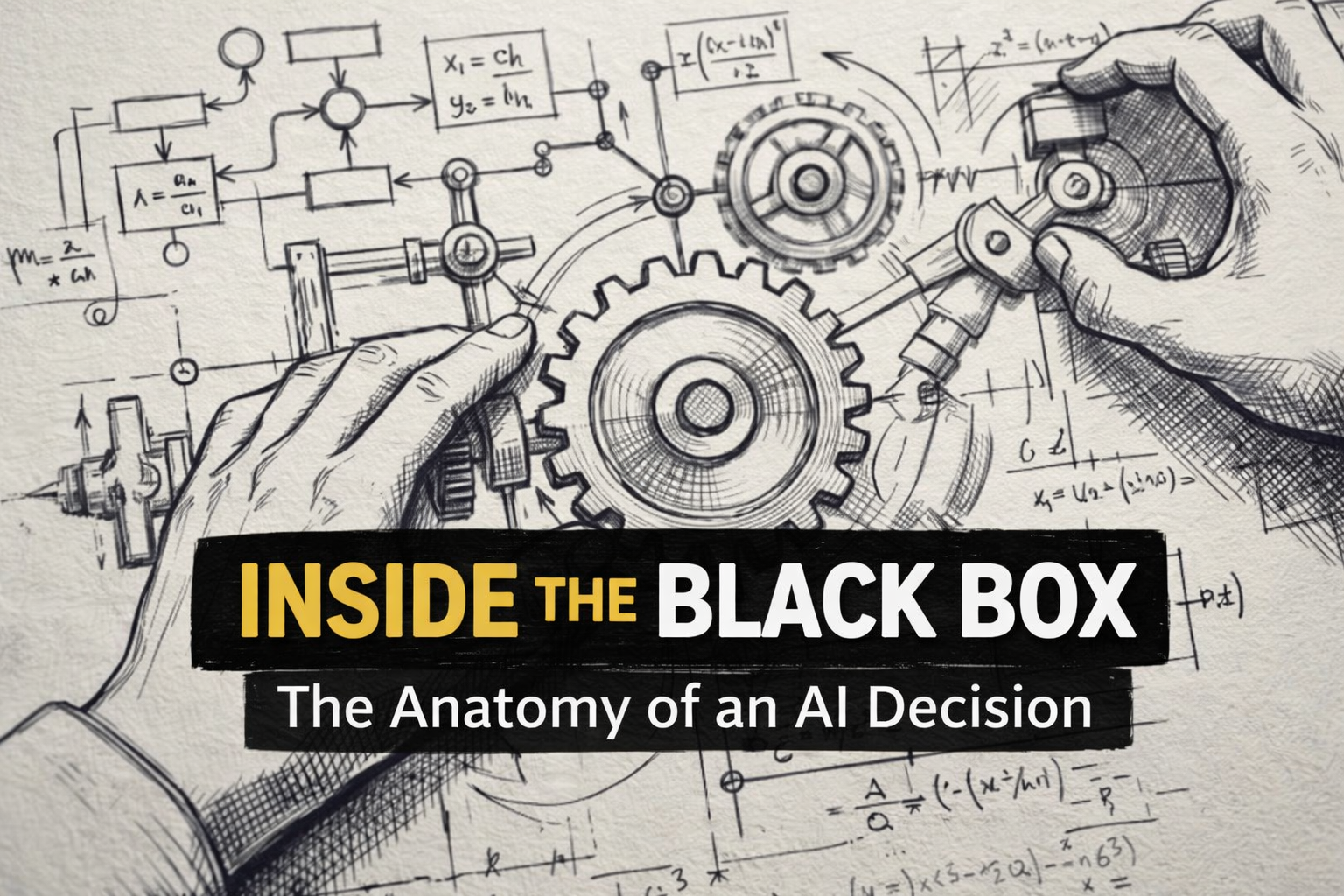
When a bank approves a mortgage or a hospital flags a disease, the final call rarely comes from a human mind anymore. It comes from mathematics.
At the core of these systems is an algorithm — a repeatable set of instructions, essentially a mathematical recipe designed to process inputs into a specific output.
From Traditional Programming to Machine Learning
For decades, software relied on traditional programming — engineers manually wrote every explicit if-then rule. If a user clicks this button, then open this page. The computer strictly followed human orders.
Machine learning completely flips that process. Instead of writing the exact rules, engineers provide the computer with massive amounts of raw data and a desired final goal. The machine analyzes the data to derive the rules itself by relying purely on the patterns it uncovers. The system acts intelligently without requiring human reasoning.
The Objective Function: How AI Knows It's Right
If human engineers aren't writing the explicit steps, how does a machine know it's making the right choice? It relies on an objective function.
An objective function is a mathematical metric that measures how far the AI's current guess is from the perfect answer. Think of it like a topographical map, where the algorithm continuously probes the terrain to minimize its error and find the lowest possible point.
Every seemingly intelligent behavior from an AI is the result of the algorithm blindly optimizing its internal math — trying to minimize its distance from that goal.
Three Ways Algorithms Learn
To map out data and derive rules, algorithms use specific training methods:
1. Supervised Learning
A technique where the algorithm is fed meticulously labeled data — like flashcards with answers on the back — to help it identify predefined patterns. This is how spam filters learn to distinguish junk mail from legitimate messages, and how image classifiers learn to identify objects in photographs.
2. Unsupervised Learning
When the algorithm is unleashed on massive datasets of unlabeled information to discover hidden clusters and relationships entirely on its own. Customer segmentation, anomaly detection, and market basket analysis all rely on unsupervised learning to find structure in chaos.
3. Reinforcement Learning
A process where the algorithm learns through trial and error within a specific environment to maximize a numerical reward — regardless of the path taken. This is how game-playing AIs master chess and Go, and how autonomous systems learn to navigate complex environments.
Inside the Neural Network: Forward Pass and Backpropagation
The algorithm is doing exactly one thing: converting real-world information into statistical relationships.
A neural network makes an initial prediction through a forward pass. The network takes inputs and multiplies them by internal weights — values that determine the strength of connections between data points — to reach a first (often incorrect) guess.
The algorithm then calculates the exact difference between its flawed prediction and the correct answer. To fix this, it uses backpropagation — a mechanism that works backward from the error to adjust internal weights.
It repeats this loop millions of times using gradient descent — an iterative optimization algorithm that finds the minimum of a function, continually pushing the error closer and closer to zero.
By continuously adjusting those numerical weights, the machine is literally writing its own rules. It transforms random guesses into precise, reliable logic.
The Limits: Bias, Black Boxes, and Accountability
The system processes probability and optimizes data. It does not comprehend the real-world context, history, or morality of the decisions it makes.
Because it builds its rules entirely from historical human data, it mathematically inherits human prejudices. This results in algorithmic bias — when a machine learning model produces systematically prejudiced results due to flawed historical data.
In practice, this translates to:
- Predictive policing tools that disproportionately target minority neighborhoods
- Financial lending models that penalize female applicants based on historical wage disparities
- Hiring algorithms that filter out qualified candidates based on patterns from biased past decisions
The Black Box Phenomenon
As these self-adjusted rules become infinitely more complex, we encounter the black box phenomenon — AI systems where the internal decision-making processes are too dense for even their creators to trace or explain.
We have traded explainability for efficiency, creating a feedback loop where:
- Individuals lose privacy and agency over decisions that affect their lives
- Organizations struggle with data quality and accountability
- Society faces severe power imbalances driven by systems that obscure their judgments
The Bottom Line
Treating algorithmic outputs as infallible, objective truths is a dangerous misconception. To ensure fair, transparent, and accountable systems, engineers must meticulously curate training data and design ethical objective functions that account for real-world harm.
An algorithm is merely a mathematical tool optimizing for a goal. Humanity is ultimately responsible for building the box — and defining its rules.